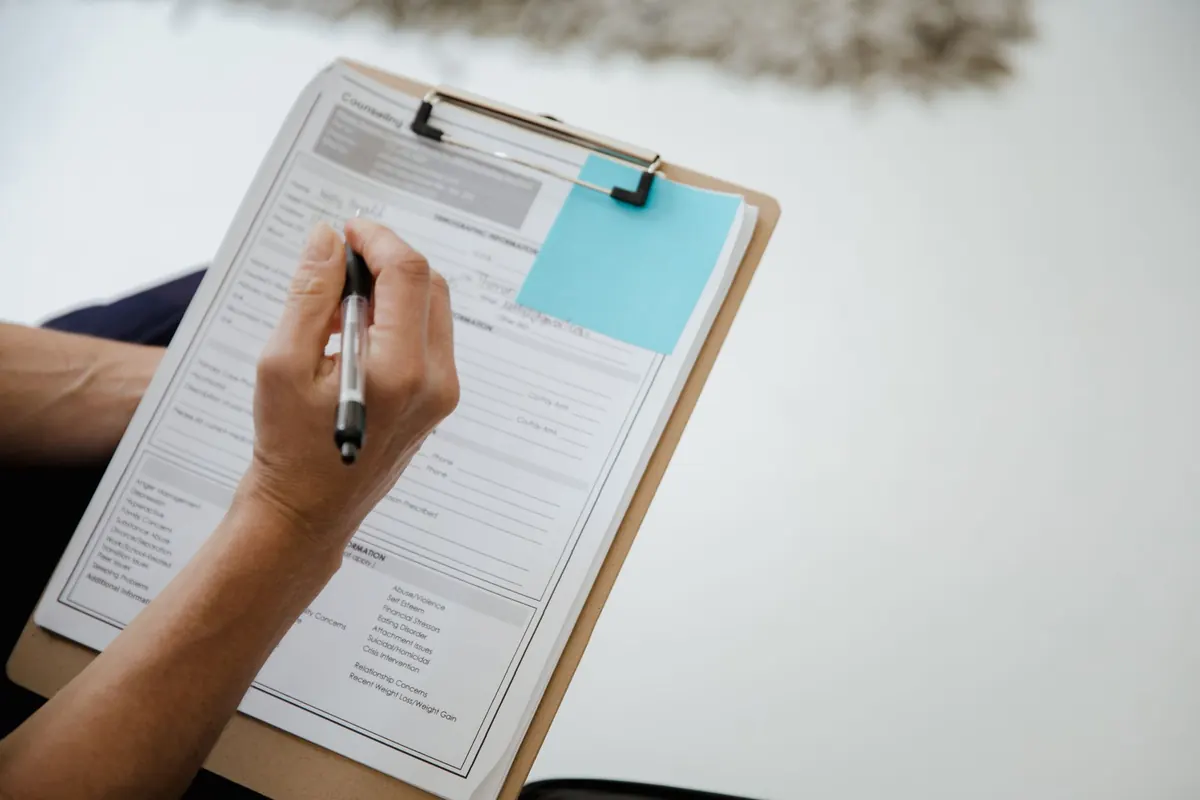
Most meeting notes don't fail because people write too little. They fail because nobody agreed on where the notes should live, what should be in them, or how anyone will find them three weeks later. You finish the call, paste a wall of text into a chat thread, and by the next meeting the details have quietly disappeared into the scroll.
The fix isn't a better app. It's a structure you use every time, whether the meeting is a five-person stand-up or a two-hour project review. Once the structure is fixed, the tool matters far less.
Start with a header that answers four questions
Before you write a single note, capture four things at the top of the page. This takes twenty seconds and saves you hours of confusion later.
- Meeting name and date — for example, "Website Redesign — Weekly Sync, 14 March".
- Attendees — names only, plus anyone who sent apologies.
- Purpose — one line on why this meeting exists. "Decide the launch date" is better than "catch-up".
- Next meeting — date and time, if there is one.
That header does more work than it looks like. When you search your notes six months later, the date and meeting name are usually the only things you remember. Give future-you something to search for.
Separate discussion from decisions from actions
The single most useful habit in meeting notes is keeping three kinds of content apart. Most people blend them into one running commentary, which is why their notes are hard to act on.
Discussion
Keep this brief and only record what you'd need to reconstruct the reasoning. You don't need a transcript. "Team debated moving the deadline to April; concern about the print run lead time" tells you everything that matters and takes ten seconds to write. If someone made a strong point you might need to quote later, put it in a blockquote or mark it clearly as a quote rather than paraphrasing badly.
Decisions
Write these as complete sentences with a subject. "Decided: launch moves to 4 April" beats "launch date discussed". A decision should be readable on its own, without the surrounding discussion, because that's how it will be read later.
Actions
Every action needs three things: a person, a task, and a date. "Priya to confirm print costs by Friday" is an action. "Print costs need checking" is a wish. If a task has no owner, it will not happen, and if it has no date, it will happen eventually or not at all.
Write notes during the meeting, tidy them after
Trying to write polished notes live means you either miss half the discussion or spend the meeting with your head down. Trying to write them from memory two days later means you invent details without noticing.
A workable rhythm is to capture rough notes as you go — fragments, initials, half-sentences — then spend five minutes immediately afterwards turning them into the structure above. Do it while the meeting is still fresh, ideally before you open your inbox. Five minutes now is worth thirty minutes of reconstruction next week.
If you're the person running the meeting, it's fair to say at the start who is taking notes and where they'll be shared. Rotating the job across the team also stops one person resenting it.
File by project, not by date or meeting type
This is where most systems break down. Notes filed only by date are impossible to browse; notes filed only by meeting name scatter a single project across a dozen unrelated pages.
A simple two-level system works well:
- Top level: the project or area. "Website Redesign", "Finance", "Client — Hartley & Co".
- Inside: a single running note, newest entries at the top. One page per recurring meeting, not one page per occurrence.
One running page per recurring meeting is the quiet hero of this approach. Instead of forty separate documents for forty weekly syncs, you have one page you scroll. Decisions and actions from last month sit directly above this month's, which makes contradictions obvious and progress easy to see.
Name documents consistently. Something like Website Redesign — Weekly Sync is findable. Notes 3 is not. If you use folders, keep them shallow; deep folder trees hide documents from everyone, including you.
Give actions a second home
Meeting notes are a record. They are not a task manager, and treating them as one guarantees things get dropped. An action buried halfway down a page of discussion is invisible by Thursday.
So after each meeting, move every action into wherever you actually track work: a task list, a project board, an assigned ticket. Then mark it in the notes — a simple "→ added to board" note beside the action is enough — so you can tell at a glance that nothing was forgotten.
If you only do one thing from this article, do this one. The gap between "we agreed to do it" and "someone is doing it" is where most meeting follow-through dies.
Review before you meet again
The last piece is the one that turns a filing system into an actual habit. Ten minutes before a recurring meeting, open the previous set of notes. Read the actions. Anything still open gets raised at the start, before new business crowds it out.
This has a useful side effect: people stop writing vague notes when they know they'll be read aloud. Knowing the notes will be reviewed makes everyone, note-taker included, slightly more precise.
Making it stick
None of this requires new software. It requires the same four moves every time: a consistent header, discussion separated from decisions and actions, filing by project with one running page per recurring meeting, and actions copied into your real task list.
Try it on one recurring meeting this week. Keep the header identical, write decisions as full sentences, and move the actions out before you close the document. After two or three rounds the structure becomes automatic, and the question "what did we agree about this?" stops being a scramble through old messages. If your notes touch on contracts, employment or financial commitments, check the detail with whoever handles that side of things before relying on a summary — notes are a memory aid, not a formal record.
Photo: janeb13 / Pixabay